Computational Space Biochemistry and Human Health: A Review of Python Libraries and Biological Databases for Astronaut Health Research
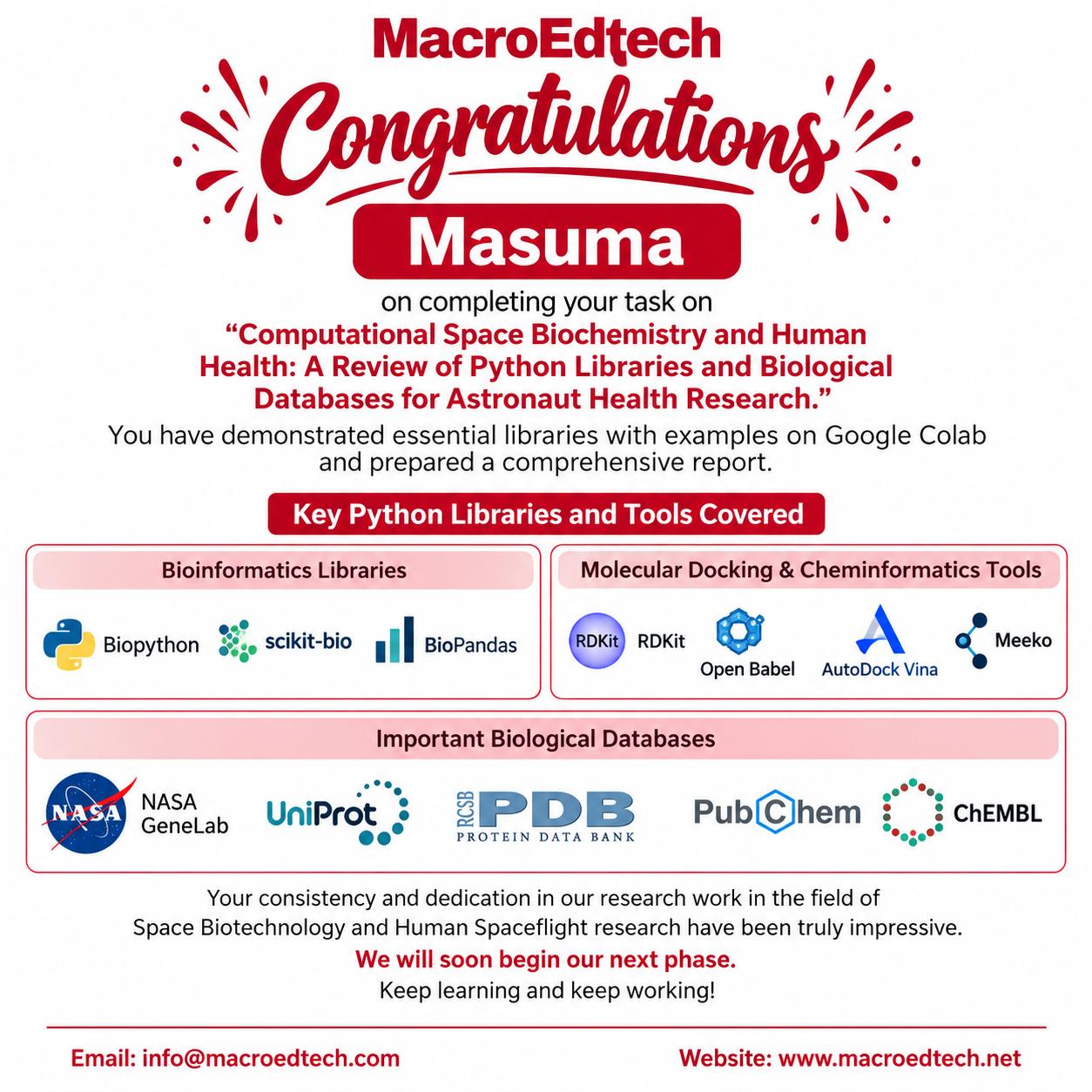
Computational Space Biochemistry is bringing together Python, bioinformatics, molecular modelling, data science, and space biology to help researchers understand astronaut health. Major libraries explored in Masuma’s work include Biopython for DNA, RNA, and protein sequence analysis; scikit-bio for sequence, diversity, and phylogenetic analysis; BioPandas for processing protein-structure data; RDKit for chemical structures, molecular descriptors, fingerprints, and compound screening; Open Babel for converting and preparing molecular file formats; Meeko for ligand and receptor preparation; and AutoDock Vina for molecular docking and protein–ligand interaction prediction. The work also explored OpenMM for molecular dynamics simulations, MDAnalysis and MDTraj for trajectory analysis, ProDy for protein flexibility and molecular motions, NumPy, Pandas, and SciPy for numerical, tabular, and statistical analysis, and Matplotlib, Plotly, PyMOL, and py3Dmol for scientific and molecular visualization. Examples were demonstrated through Google Colab, including DNA-to-protein translation, DNA composition analysis, PDB structure processing, molecular structure representation, docking preparation, basic molecular dynamics, trajectory analysis, statistical analysis, and 3D protein visualization. These tools can be applied to research areas such as microgravity-related bone and muscle loss, oxidative stress, DNA damage, immune-system changes, protein dynamics, biomarker analysis, and computational drug discovery. The project also connected these tools with databases including NASA OSDR/GeneLab, UniProt, PDB, PubChem, ChEMBL, KEGG, Reactome, and NCBI GEO, demonstrating a possible workflow from biological data retrieval to computational analysis and biological interpretation.
Work prepared by Masuma, Research Assistant, MacroEdtech. Please review the Google Colab notebook and attached PDF report.
Google Colab : https://colab.research.google.com/drive/18Brsmpos5bdlYOnQX_LHQpSTcSbe3GX-?usp=sharing